
Knowing the notes on the fretboard turns shapes into music you understand. You'll find the roots of barre chords faster, move scales to new keys and follow what a teacher means by "play an A on the low E string". The good news for left-handed players: every note sits on exactly the same string and fret as it does for a right-handed player. Only the picture is mirrored.
This guide builds the fretboard up in small steps. You'll learn the musical alphabet, the open strings, how each fret moves a note up, and two quick ways to find any note again. Keep your guitar nearby and say each note name out loud as you play it.
Start with the musical alphabet
Music uses seven letter names: A, B, C, D, E, F and G. After G, the letters start again at A. Between most of these letters there is an extra note, called a sharp (♯) or a flat (♭). A sharp raises a note by one fret, and a flat lowers it by one fret. So the note between A and B can be called A♯ or B♭. On a guitar, both names describe the same sound.
Two pairs of letters have no note between them: B and C, and E and F. Remember "B to C, E to F" and the rest follows. That gives twelve different notes in total:
A · A♯/B♭ · B · C · C♯/D♭ · D · D♯/E♭ · E · F · F♯/G♭ · G · G♯/A♭
After G♯, the next note is A again, only higher. The distance from one A to the next is called an octave. You'll hear that the two notes sound alike, which is why they share a name.
Learn the six open strings
In standard tuning, the open strings from thickest to thinnest are E, A, D, G, B and E. To tell the two Es apart, we call the thickest one low E and the thinnest one high e. A silly phrase can help you remember the order: Eddie Ate Dynamite, Good Bye Eddie.
On a left-handed guitar the neck points to your right and the thickest string is still nearest the ceiling. Our horizontal diagrams put the nut on the right, high e at the top and low E at the bottom, so the picture matches your view as you look down at the guitar. Our vertical chord diagrams put high e on the left.
Quick check
Pick each open string from thickest to thinnest and say its name: E, A, D, G, B, e. Then go from thinnest to thickest. If you have a tuner, play each string and check the letter it shows. Saying the names out loud feels odd at first, but it links the sound, the string and the name together.
Every fret is one step up
Each fret raises a note by one half step, the smallest step in most Western music. That makes counting simple. On the low E string, fret 1 is F, fret 2 is F♯ (also called G♭), fret 3 is G, and so on up the alphabet. Because there is no note between E and F, the first fret goes straight from E to F.
At fret 12 the pattern starts again: every string plays its open note one octave higher. Fret 12 is usually marked with a double dot. Frets 13 and above repeat frets 1 to 12, an octave up, so once you know the first twelve frets you know the whole neck.
Use the fret markers
Most guitars have dots or inlays at frets 3, 5, 7, 9 and 12. They're just signposts, but they help a lot. Learn which notes live at those frets on the two thickest strings and you'll always have a landmark nearby. Some guitars also have small dots on the side of the neck, which are easier to see while you play.
Learn the two lowest strings first
The low E and A strings are where most chord roots live, including the roots of barre chords and power chords. Start with the natural notes (the ones without sharps or flats) on these two strings.
| Note | Low E string | A string |
|---|---|---|
| E | open and 12 | 7 |
| F | 1 | 8 |
| G | 3 | 10 |
| A | 5 | open and 12 |
| B | 7 | 2 |
| C | 8 | 3 |
| D | 10 | 5 |
Sharps and flats sit one fret above or below the natural notes. F♯ is at fret 2 on low E, and B♭ is at fret 1 on the A string. Learn one string at a time: play up the low E string saying each natural note, then do the same on the A string.
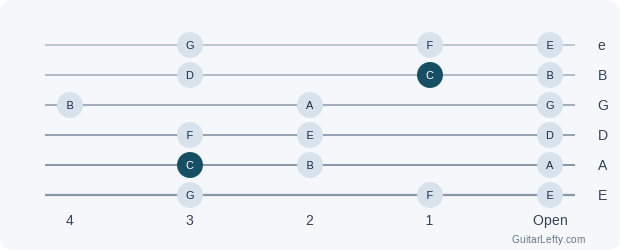
Find the same note on another string
Once you know a note on a low string, you can find it again higher up with an octave shape. Two shapes cover most of the neck.
Two strings over, two frets up
From a note on the low E string, skip one string and move two frets up, towards the body. You land on the same note name on the D string. G at fret 3 on low E becomes G at fret 5 on the D string. The same shape works from the A string to the G string: C at fret 3 becomes C at fret 5.
Watch out for the B string
The B string is tuned a little differently, so shapes that cross it shift by one fret. From the D string to the B string, or from the G string to high e, move three frets up instead of two. The open D string's D appears again at fret 3 on the B string.
On a left-handed guitar, "up the neck" means towards the body. That's to the left as you look down at the strings, and away from the nut on our horizontal diagrams.
Use the fifth-fret trick
Fret 5 on each string plays the same note as the next open string, with one exception. Fret 5 on low E is A, the same note as the open A string. Fret 5 on A is D, fret 5 on D is G, and fret 5 on B is E. On the G string you need fret 4 to match the open B string. Many players use this pattern to tune by ear, and it's a quick way to check a note name.
A five-minute daily routine
- Choose one note name, for example G.
- Find it on the low E string and on the A string. Say "G" as you play each one.
- Use an octave shape to find two more Gs higher up the neck.
- Play every G you found, slowly, from the lowest to the highest.
- Tomorrow, choose a new note. After seven days you'll have covered every natural note.
The interactive fretboard shows every note in any key on a left-handed neck, and the fretboard quiz turns this routine into a ten-question game with hints.
Put the notes to work
Note names make other skills easier. When you know A is at fret 5 on low E, you can play an A barre chord or start an A minor pentatonic scale from that spot. Our A minor pentatonic lesson shows where those roots sit. Knowing the notes also helps you understand intervals and build triads anywhere on the neck.
Common questions
Are the notes different on a left-handed guitar?
No. Fret 3 on the low E string is G on every guitar in standard tuning. Left-handed diagrams are mirrored so the picture matches your view, but the string and fret numbers are the same.
Should I say sharp or flat?
Both names are correct. The key of a song decides which one is used. In the key of D you'll usually see F♯; in the key of F you'll see B♭. For now, learn the natural notes and remember that a sharp is one fret up and a flat is one fret down.
How long does it take?
It varies from person to person. A few minutes a day works better than one long session. Start with the low E and A strings, and add another string once those feel familiar.
Prepared for Guitar Lefty with AI assistance. The written exercises are original teaching examples. All fret numbers assume standard tuning unless stated otherwise.