
A triad is a chord made of three notes: a root, a third and a fifth. Triads are the building blocks inside every major and minor chord you play. Learning them as small three-string shapes lets you play chords anywhere on the neck, keep your sound clean alongside other instruments and understand what your fingers are doing.
This guide uses standard tuning. Fret numbers are the same on left- and right-handed guitars; only the diagrams are mirrored. If you'd like a refresher first, read about intervals, which explain the thirds and fifths in each triad.
What makes a triad
Every triad starts with a root, the note the chord is named after. Above it sits a third, and above that a fifth. The size of those intervals decides the type of triad:
| Triad | Formula | In C | Sound |
|---|---|---|---|
| Major | 1 – 3 – 5 | C E G | Bright and settled |
| Minor | 1 – ♭3 – 5 | C E♭ G | Darker and softer |
| Diminished | 1 – ♭3 – ♭5 | C E♭ G♭ | Tense and unstable |
| Augmented | 1 – 3 – ♯5 | C E G♯ | Dreamy and unresolved |
An open C chord, x–3–2–0–1–0, has five strings ringing but only three different notes: C, E and G. Triad shapes keep just one of each.
Why learn small shapes?
- They're movable: one shape plays any major chord as you slide it along the neck.
- They're light: three fingers or fewer, with no full barre.
- They sit well with other instruments, because they leave room for the bass and other parts.
- They show you where the root, third and fifth are, which helps when you start to play solos.
Inversions: three ways to stack the same notes
The three notes of a triad can appear in any order. When the root is the lowest note, the triad is in root position. With the third lowest, it's in first inversion; with the fifth lowest, it's in second inversion. All three are still C major. They just sound slightly different and sit in different places on the neck.
C major on the top three strings
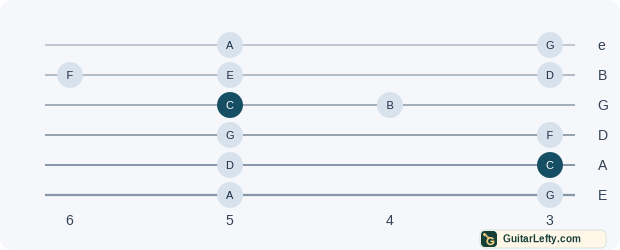
The G, B and high e strings are a popular home for triads. Here are the C major shapes, with frets written from the G string to high e.
| Shape | Frets (G – B – e) | Lowest note |
|---|---|---|
| Second inversion | 0 – 1 – 0 | G (the top of an open C chord) |
| Root position | 5 – 5 – 3 | C |
| First inversion | 9 – 8 – 8 | E |
| Second inversion, an octave up | 12 – 13 – 12 | G |
Play each shape, then slide between them along the neck. Notice that the shapes repeat after twelve frets.
Make it minor
To turn a major triad into a minor triad, lower the third by one fret. In each C major shape, find the E and move it down to E♭:
| C minor shape | Frets (G – B – e) |
|---|---|
| Root position | 5 – 4 – 3 |
| First inversion | 8 – 8 – 8 |
| Second inversion | 12 – 13 – 11 |
Play a C major shape and its C minor partner one after the other and listen to the change. It's one note and one fret, but the mood is completely different.
Triads on the D, G and B strings
The same idea works one string set lower. The shapes look a little different because of the B string's tuning. Here is C major on the D, G and B strings:
| Shape | Frets (D – G – B) | Lowest note |
|---|---|---|
| First inversion | 2 – 0 – 1 | E (part of an open C chord) |
| Second inversion | 5 – 5 – 5 | G |
| Root position | 10 – 9 – 8 | C |
Move a shape to any chord
Every fretted shape is movable. Slide the root-position shape 5 – 5 – 3 up two frets to 7 – 7 – 5 and it becomes D major. Slide it down two frets to 3 – 3 – 1 and it becomes B♭ major.
Find the root in each shape
To name the chord, find its root. In root position the root is the lowest of the three notes. In first inversion it's the highest, and in second inversion it's the middle note. Our guide to fretboard notes helps you name the root quickly.
Play a progression with triads
Try G, C and D using shapes that sit close together on the top three strings:
| Chord | Frets (G – B – e) | Shape |
|---|---|---|
| G major | 4 – 3 – 3 | First inversion (B lowest) |
| C major | 5 – 5 – 3 | Root position |
| D major | 7 – 7 – 5 | Root position |
Strum each chord four times with your left hand and keep your right-hand movements small. Then play the same chords as full open shapes and notice how different they sound. The chord progression builder plays loops in any key, so you can practise these triads with a backing.
Use triads alongside another guitarist
When two guitarists play the same open chords, the sound can get crowded. If one player strums open chords, the other can play the same chords as small triads higher up the neck. The notes match, but the parts sit in different registers, so both are easier to hear. The same idea works when you play along with a recording: a triad shape often fits more neatly than a full six-string chord.
Which strings should I use?
Start with the top three strings, where triads sound clear and bright. The D, G and B strings give a slightly warmer sound. Triads on the three thickest strings can sound muddy, especially low on the neck, so most players keep them for the higher string sets.
A ten-minute triad routine
- Two minutes: play the four C major shapes on the top strings, from low to high.
- Three minutes: change each one to C minor and back again.
- Three minutes: move the root-position shape to D, E, F and G.
- Two minutes: play the G – C – D progression above.
Common questions
Where do diminished and augmented triads fit?
Lower the fifth of a minor triad by one fret and you have a diminished triad. Raise the fifth of a major triad by one fret and you have an augmented triad. They appear less often than major and minor triads, usually as passing chords between them.
Which fingers should I use?
Use whatever lets all three notes ring clearly. When two notes share a fret on neighbouring strings, one finger can lie flat across both. Keep your thumb relaxed behind the neck, and stop if anything hurts.
Prepared for Guitar Lefty with AI assistance. The written exercises are original teaching examples. All fret numbers assume standard tuning unless stated otherwise.