
An interval is the distance between two notes. Intervals explain why a major chord sounds bright, why a minor chord sounds darker and why some notes in a solo feel like home. On guitar they're easy to see, because each fret is one step. This guide shows you the main intervals, where they sit on a left-handed neck and how to hear them.
You don't need to read music. If you know the open strings, and that each fret raises a note by one half step, you're ready. If not, start with our guide to the notes on the fretboard.
Half steps and whole steps
A half step is one fret. A whole step is two frets. Play the open low E string, then fret 1: that's a half step, from E to F. Play fret 1 and then fret 3: that's a whole step, from F to G. Every interval can be counted in half steps, which makes intervals easy to measure on a guitar.
Fret numbers are the same on left- and right-handed guitars, so everything in this guide works on any guitar in standard tuning. Only our diagrams are mirrored.
The intervals in one octave
Each interval has a name based on its size. This table counts up from C. You can check every row on the A string by starting from C at fret 3 and moving up the number of frets shown.
| Half steps (frets) | Interval | From C | Short name |
|---|---|---|---|
| 0 | Unison | C | 1 |
| 1 | Minor second | D♭ | ♭2 |
| 2 | Major second | D | 2 |
| 3 | Minor third | E♭ | ♭3 |
| 4 | Major third | E | 3 |
| 5 | Perfect fourth | F | 4 |
| 6 | Tritone (augmented fourth or diminished fifth) | F♯ or G♭ | ♯4 or ♭5 |
| 7 | Perfect fifth | G | 5 |
| 8 | Minor sixth | A♭ | ♭6 |
| 9 | Major sixth | A | 6 |
| 10 | Minor seventh | B♭ | ♭7 |
| 11 | Major seventh | B | 7 |
| 12 | Octave | C | 8 |
The short names are the numbers you'll see in our scale lessons and chord formulas. A major chord's formula, 1 – 3 – 5, means root, major third and perfect fifth.
Measure intervals along one string
The simplest way to play an interval is along a single string. Play a note, then count frets up the neck. From C at fret 3 on the A string, four frets up (fret 7) is E, a major third. Seven frets up (fret 10) is G, a perfect fifth. This is clear to see, but it needs big jumps along the neck, so guitarists usually play intervals across the strings instead.
Interval shapes across the strings
In standard tuning, most neighbouring strings are a perfect fourth apart (five frets). The exception is G to B, which is a major third (four frets). That gives us shapes you can move anywhere. In this table, "next string" means the next thinner string, and "higher" means towards the body.
| Interval | E to A, A to D or D to G | G to B |
|---|---|---|
| Perfect fourth | Same fret, next string | One fret higher |
| Major third | One fret lower, next string | Same fret |
| Minor third | Two frets lower, next string | One fret lower |
| Perfect fifth | Two frets higher, next string | Three frets higher |
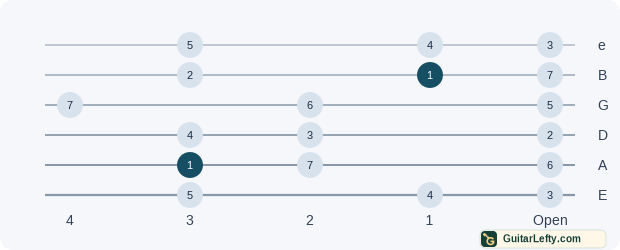
Try it: play C at fret 3 on the A string. The E above it is at fret 2 on the D string, one fret lower: a major third. The G is at fret 5 on the D string, two frets higher: a perfect fifth.
The octave shape
An octave skips one string. From the low E string to the D string, or from the A string to the G string, it's two frets higher. If the shape crosses the B string (D to B, or G to high e), it's three frets higher. C at fret 3 on the A string appears again at fret 5 on the G string.
Learn how intervals sound
Each interval has its own character. Play each pair slowly, first one note after the other, then both together. Describe what you hear in your own words; there's no wrong answer.
- Perfect fifth: open and strong. It's the sound of a power chord.
- Major third: bright and settled. It makes a chord major.
- Minor third: softer and darker. It makes a chord minor.
- Perfect fourth: open, and a little unfinished.
- Tritone: tense and restless. It wants to move somewhere.
- Minor seventh: bluesy. It turns a major chord into a dominant seventh.
Intervals build chords
A chord is a stack of intervals above a root. Stack a major third and a perfect fifth on C and you get C, E and G: a C major chord. Swap the major third for a minor third, E♭, and you have C minor. Add a minor seventh, B♭, to C major and it becomes C7.
Every chord lesson on this site lists its formula. The E7 lesson, for example, shows 1 – 3 – 5 – ♭7. Once you can find those intervals, you can build the chord from any root.
Intervals build scales
A scale is a pattern of steps. The major scale goes whole, whole, half, whole, whole, whole, half. From C that gives C, D, E, F, G, A, B and C again, with no sharps or flats. The natural minor scale goes whole, half, whole, whole, half, whole, whole. Compare C major with A minor: they use the same notes but start from different roots, so they feel different.
Switch the labels on the interactive fretboard to intervals and you'll see each scale's numbers on every string.
Use intervals when you improvise
Intervals also help you choose which notes to land on. Over a C major chord, ending a phrase on C (the root) sounds finished. Ending on G (the fifth) sounds stable but open, and ending on E (the major third) sounds sweet and very "major". Try a short phrase from the C major pentatonic scale and finish it on each of those notes in turn.
Over a C minor chord, the third is E♭ instead of E. That one note is the difference between a happy and a sad ending, which is why it pays to know where the third sits in every chord shape you use.
Avoid the counting mistake
When you count an interval in frets, the starting fret is zero, not one. From fret 3 to fret 7 is four frets, so it's four half steps: a major third. If you count the starting fret as one, every interval comes out one step too big. Counting out loud, "zero, one, two, three, four", helps at first.
A ten-minute interval routine
- Two minutes: play each interval in the first table along the A string from C. Say its name.
- Three minutes: play the major third and perfect fifth shapes across the strings from three different roots.
- Three minutes: play a C major chord, then play its root, third and fifth one at a time.
- Two minutes: play the minor third shape and listen to how it changes the mood.
When the shapes feel familiar, try the fretboard quiz in interval mode.
Common questions
Do interval shapes change for left-handed players?
The fret numbers are the same. A perfect fifth is still two frets higher on the next string. The shape only looks mirrored on a diagram, because the strings are drawn the other way round.
Why are some intervals called perfect?
Unisons, fourths, fifths and octaves are called perfect. The others come in major and minor sizes. It's a naming tradition; for playing, counting the frets is what matters.
Prepared for Guitar Lefty with AI assistance. The written exercises are original teaching examples. All fret numbers assume standard tuning unless stated otherwise.