
A guitar scale is a collection of notes organised around a root. Learning one helps you find melodies, recognise sounds and understand how notes relate to chords. Left-handed playing changes the physical view of the neck, but it does not change a scale’s notes or interval formula.
You do not need all thirteen scale families on the site at once. Begin with one major scale, one natural minor scale and a pentatonic sound you enjoy. Learn a short route, hear its root, and use a few notes in a phrase before collecting more diagrams.
A note is not the same thing as a fret location
The same note can appear in several places on a guitar. E, for example, is an open string name, but you can also find E on other strings and at higher frets. A diagram shows locations; the scale describes the note collection. Keeping those ideas separate makes the neck less mysterious.
In standard tuning, the open strings are E–A–D–G–B–e from thickest to thinnest. Moving one fret towards the body raises the pitch by one semitone. Two frets make a whole tone. On our left-handed horizontal diagrams, that move towards higher fret numbers runs leftwards because the nut is on the right.
After twelve frets, you reach the same note name an octave higher on the same string. The pitch is higher, but its letter name repeats. That is why a scale can span several octaves while using the same seven or five note names again.
Start by finding a few named landmarks instead of memorising every fret immediately. On low E, fret three is G, five is A and seven is B. On A, fret three is C and five is D. Say the names while playing them. A known root gives a pattern a meaningful address.
Use the fretboard tool to check a location, then try to find it again without looking. You are building a connection between a name, a sound and a place your hand can reach. All three become useful when you begin improvising or moving a chord shape.
Hear what the root does
The root names the scale. C is the root of C major; A is the root of A natural minor. It is a useful place to begin an exercise and often a satisfying place to end a phrase. Our dark diagram dots identify roots so you can find them quickly.
Try playing a C chord, then a few notes from C major, finishing on C. Let that note ring. Next finish a phrase on B and notice the different effect. Neither choice is forbidden, but they do different jobs. One may feel settled while the other suggests that the music could continue.
The surrounding harmony matters. A collection of notes printed from A to A does not automatically make a piece sound like A minor. Chords, repeated bass notes, emphasis and phrase endings help establish the centre. That is why relative scales can share notes while sounding different in music.
A drone is a sustained or repeated reference note. Playing a scale against a quiet root drone can help you hear each interval without changing chords. Start with a simple sound at a comfortable volume. The aim is to listen to relationships, not to cover up uncertain notes with a large backing track.
For an early exercise, choose three notes including the root. Play a short phrase that ends on the root, then repeat it with another ending. Ask what changed in the feeling of completion. You do not need an advanced theory label for every effect before your ears can notice it.
Understand intervals with a single string
An interval describes the distance between notes. A semitone is one fret; a whole tone is two. The major scale follows the step pattern whole, whole, half, whole, whole, whole, half. Here “half” means a semitone, not half a fret.
Try C major on the A string: fret three C, five D, seven E, eight F, ten G, twelve A, fourteen B and fifteen C. This is a long physical route, so move gently and do not treat it as a speed drill. It makes the whole and half steps easy to see.
Scale degrees label the relationships from the root: one, two, three, four, five, six and seven. The next C is the octave, often called eight in an ascending exercise. A formula such as 1–2–3–5–6 selects particular degrees of the major scale, rather than asking you to play those fret numbers.
A flat in an interval formula lowers a degree by a semitone compared with the major reference. “Flat three” in A means C instead of C sharp. It does not mean that every written note must have a flat sign. The interval label and the note’s spelling answer different questions.
Sharps and flats also help spell each seven-note scale with the appropriate letter names. G major uses F sharp, while F major uses B flat. On an equal-tempered guitar, two spellings can share a fret, but the spelling can still show the note’s role. Start with friendly keys before worrying about every enharmonic name.
Begin with C major
C major contains C, D, E, F, G, A and B. It has no sharps or flats in its standard spelling, making it convenient for learning note names. That does not make it the only beginner scale or the easiest physical route in every position.
Here is one open-position octave: A three, D open, D two, D three, G open, G two, B open, B one. The notes rise C–D–E–F–G–A–B–C. Play one note at a time, then return by the same route.
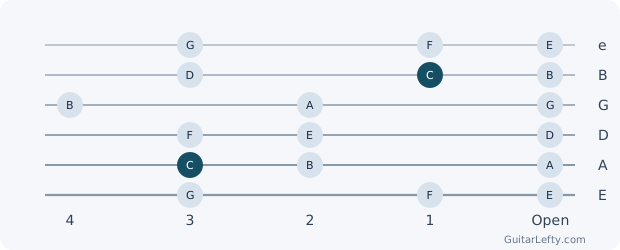
Try index at fret one, middle at two and ring at three as a starting fingering. Open strings need no fretting finger. Keep unused fingers nearby without forcing a rigid one-finger-per-fret stretch. The route should fit the music and your hand comfortably.
Now play C, E and G using A three, D two and G open. Those notes form the C major triad. Play them one after another, then compare them with a C chord. This connects scale practice with harmony instead of leaving the scale as a separate finger exercise.
Visit the C major lesson for more windows and a sheet. Stay with one octave until you can identify the two Cs and play a short phrase that ends on one of them. A clear musical landmark is worth more than another memorised box.
Compare A natural minor and E natural minor
Natural minor uses the degrees 1, 2, flat 3, 4, 5, flat 6, flat 7. A natural minor contains A, B, C, D, E, F and G. It shares its pitch collection with C major, while A is the intended centre.
For one octave of A natural minor, play A open, A two, A three, D open, D two, D three, G open and G two. Say A–B–C–D–E–F–G–A. Then strum Am and make a short phrase ending on A. Compare that with the C-major-centred exercise.
E natural minor contains E, F sharp, G, A, B, C and D. A convenient octave is low E open, two and three; A open, two and three; D open and two. The F sharp is important. Leaving it out moves you towards a different collection rather than an exact E natural minor run.
The scale’s character is not a promise about mood. Minor music can be energetic, calm, tense or playful. Listen to the interval relationships and harmony instead of forcing every major example into “happy” and every minor example into “sad”. Those shortcuts become limiting quite quickly.
Use the A minor and E minor lessons to compare roots, notes and nearby chords. Learn one route well enough to play without reading every note, then use the diagram to explore a new phrase rather than immediately a new key.
Move from seven notes to five, then add a blue note
Minor pentatonic selects 1, flat 3, 4, 5 and flat 7. A minor pentatonic is A, C, D, E and G. Compared with A natural minor, B and F are absent. That gives you fewer notes to organise, but it does not remove the need to listen to the chords.
Major pentatonic selects 1, 2, 3, 5 and 6. G major pentatonic is G, A, B, D and E. It shares pitch classes with E minor pentatonic. Try one phrase against G, then another against Em, paying attention to the different resting note.
Minor blues adds a flat fifth to minor pentatonic. A minor blues is A, C, D, E flat, E and G. The E flat sits between D and E. Try D–E flat–E as a short movement, then rest on A or E. Holding the added note for a long time creates a different effect from passing through it.
Major blues adds a flat third to major pentatonic. In C, that gives C, D, E flat, E, G and A. The move from E flat to E can create a recognisable pull from the minor third towards the major third. Use it over suitable harmony rather than treating it as a universal major-key ingredient.
The pentatonic guide has original phrases and routes. The A minor blues lesson adds the extra colour when you are ready. Learn the five-note sound first so you can hear exactly what the added note changes.
Understand harmonic and melodic minor
Harmonic minor raises natural minor’s seventh degree. A harmonic minor is A, B, C, D, E, F and G sharp. That G sharp can pull strongly towards A. It also supports an E major chord, whose notes are E, G sharp and B, resolving towards Am.
Try G sharp on the G string at fret one followed by A at fret two. Hear the semitone movement. Then compare G open followed by A two. These are small, playable examples of the difference between the natural seventh relationship and the flat seventh relationship above A.
Do not assume that a minor-key song uses one unchanged scale over every chord. Many minor-key pieces draw on more than one form of minor. Listen to the melody and harmony. A raised seventh may be especially relevant over a dominant chord leading home.
The melodic minor family on this site uses the jazz form: 1, 2, flat 3, 4, 5, 6 and 7 in both directions. A jazz melodic minor is A, B, C, D, E, F sharp and G sharp. Classical teaching often uses that raised sixth and seventh ascending, then natural minor descending.
Those are different conventions, so check which a lesson means. Our melodic minor collection states its choice explicitly. For a beginner, these scales can wait until you want their particular sound; understanding the labels now does not mean you must practise all of them today.
Treat modes as sounds around a centre
A mode is easier to understand when you hear a centre and its characteristic intervals. Playing the white-note collection from a different starting note is one way to display modal notes, but a start note alone does not establish a modal piece of music.
Dorian is a minor-type mode with a natural sixth. A Dorian is A, B, C, D, E, F sharp and G. Compare F sharp with A natural minor’s F. Try an A-centred minor groove that supports the natural sixth, and listen to that changed note deliberately.
Mixolydian is major-type with a flat seventh. G Mixolydian contains G, A, B, C, D, E and F. Compare the F with G major’s F sharp. A static G7 harmony gives the flat seventh a clear context, though other notes may still need thoughtful phrasing.
Lydian raises the fourth of major. C Lydian has F sharp instead of F. Phrygian lowers the second of natural minor: E Phrygian has F instead of F sharp. Locrian includes a flat fifth and often appears in discussion of half-diminished harmony. These are distinct colours, not progressively “better” versions of beginner scales.
Choose one modal comparison at a time. Play the familiar scale, change the characteristic note, and listen against a suitable drone or chord. The scale comparison tool highlights shared and different notes, helping you focus on the actual relationship instead of two large maps.
Choose routes, windows and fingerings on purpose
A scale can be played along one string, across several strings, within a compact position or through shifting positions. Each route makes different movements convenient. There is no single route that replaces every other way of playing the same notes.
Our windows show overlapping parts of the neck. They do not automatically represent the five CAGED chord forms. CAGED is a way to connect chord shapes and roots, explained in its own guide. A window is simply a useful view.
When learning a new route, identify the lowest intended note, the roots and the highest intended note. Decide whether you are playing a root-to-root octave or all available notes in a position. Both are useful exercises, but they have different endpoints.
Check that your sequence actually rises if the task is an ascending scale. Moving to a thinner string often raises the pitch, but an arbitrary fret choice can still move down. The fretboard’s note labels and audio help you verify the route rather than relying only on the visual direction of your hand.
Use finger suggestions as practical starting points. A fingering that works for a slow scale run may change for a bend, slide or repeated phrase. Make that change consciously, keeping the notes and timing correct. Comfortable, clear playing matters more than making your hand look like a printed diagram.
Practise scales as music, not only as lists
Begin with a slow root-to-root octave. Then stop running the whole scale and choose three notes. Repeat a short rhythm using those notes, leave a gap, and answer it. The smaller collection makes each musical decision easier to hear.
Try ending on the root, then the third, then the fifth against a tonic chord. These notes outline its triad. Compare a held scale note that is not in that chord. You are learning the difference between a comfortable resting point and a note that may invite movement.
Use the practice room for a steady pulse, but keep the exercise slow enough to listen. A timer can organise a session; it cannot tell you whether you heard the root or played the intended rhythm. Make those listening checks part of the task.
When you add speed, keep the same clear starts and controlled endings. If those disappear, reduce the tempo. Practising an unclear route faster is unlikely to solve the uncertainty. Short repetitions with a clear target make it easier to notice what needs changing.
Download one sheet from the print collection and mark a route or phrase in your own notes. A physical reference can help you focus on playing rather than browsing through more possibilities. Return to the full map when you have a question the small route cannot answer.
Build a chord from a scale, then hear it
Write C major as C, D, E, F, G, A, B. Start on C and choose every other scale note until you have three: C, E and G. That is the C major triad, using scale degrees one, three and five.
Now start on A within the same collection. Choose A, C and E. Relative to A, those notes are root, minor third and fifth, so the result is Am. The shared key collection contains both major and minor chords; a chord’s quality depends on its own intervals.
You can hear this with nearby locations. Play C on A three, E on D two and G open, one after another. Then play A open, C on A three and E on D two. The second example changes strings and locations, but the important listening difference is the new root and third relationship.
Try the process on G major: G, A, B, C, D, E, F sharp. Starting on G gives G, B and D. Starting on E gives E, G and B, the Em triad. Write the names first, then use the fretboard tool to find a comfortable route.
This exercise explains why chord practice and scale practice belong together. You can play a scale, pause on its chord tones and hear a harmonic outline. You can also begin with a chord and explore the scale notes around it. Neither needs to remain an isolated list of finger movements.
Keep the first attempt in one friendly key. Naming all seven triads in every key can wait. A clear C-versus-Am comparison gives you a small relationship you can hear, play and explain, which is a stronger foundation than a large table you have not yet connected to sound.
Keep relative and parallel comparisons distinct. C major and A natural minor share notes and are relative scales. A major and A natural minor share a root and are parallel scales. Ask which feature is being kept when you compare two sounds: the pitch collection or the home note.
Choose your next scale by its musical job
If you want to understand note names and basic harmony, begin with C major. If you want an open-position minor sound, try E natural minor. If your goal is making a first short solo, choose A minor or E minor pentatonic. These are useful starting choices, not mandatory steps in a fixed ladder.
Add a new key when you need to play with a song, a singer or another musician in that key. Add a new scale family when you want a sound the current collection does not provide. Knowing why you are adding it helps you use it instead of only storing another pattern.
For the next ten minutes, pick one scale, find two roots and play a phrase that connects them. Name at least one interval or note you used. Finish with a short idea you can repeat tomorrow. You are building a usable understanding of the neck, one clear sound at a time.
Prepared for Guitar Lefty with AI assistance. The written exercises are original teaching examples. All fret numbers assume standard tuning unless stated otherwise.