
A pentatonic scale has five notes per octave. That small collection is a friendly place to begin making melodies, because you can spend more time listening and less time remembering a long pattern. Start with a few notes, give them a rhythm, and leave space for the sound to settle.
In this guide you will explore A minor, E minor and G major pentatonic. You will learn a clear route for each, then turn the notes into original short phrases. The examples use standard tuning and a normal left-handed string arrangement, with your right hand fretting and your left hand picking.
What makes a scale pentatonic?
“Penta” means five. In a minor pentatonic scale, the degrees are 1, flat 3, 4, 5 and flat 7. In A minor pentatonic, those notes are A, C, D, E and G. The numbers describe each note’s relationship to A, the root.
A major pentatonic scale uses 1, 2, 3, 5 and 6. G major pentatonic contains G, A, B, D and E. You do not need to memorise the formulas before playing, but they help you understand why a familiar shape can produce different sounds around different roots.
A scale is a set of available notes, not a complete solo. Rhythm, repetition, silence, note length and the chords underneath all affect the result. You can make a recognisable phrase with three notes. You can also make a long scale run that says very little. Begin by choosing rather than filling every space.
Pentatonic notes are not guaranteed to sound equally settled over every chord. The root can feel like home, while other notes create movement or tension. Listen to the backing harmony. If a note clashes in a way you do not want, move to a chord tone or change the phrase rather than assuming the scale label makes every choice correct.
Read the fret window and find the roots
Our horizontal diagrams put high e at the top and the nut to the right. Higher fret numbers run leftwards. Read the printed string and fret labels first. Dark dots mark roots; lighter dots are the other notes. You are looking at a map, not a left-to-right timeline.
The A minor example begins around fret five. On the low E string, fret five is A and fret eight is C. On the A string, fret five is D and fret seven is E. Saying those locations aloud is a dependable way to connect the picture with your hands.
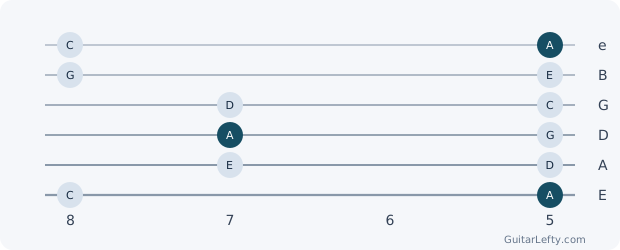
Try finding every A in the window before playing a full sequence. In the familiar two-note-per-string route below, A appears at low E five, D seven and high e five. Stop on each one and say its name. Roots help you orient the pattern and give your phrases a place to finish.
The site’s diagram windows overlap. They show portions of the neck rather than prescribing one universal fingering or automatically naming a CAGED pattern. Choose a route through the notes deliberately. Later, use a shared note to move from one window to another without losing track of the sound.
Play A minor pentatonic around fret five
This is a common two-note-per-string route. The table runs from the thickest string to the thinnest. Play the first fret in a row, then the second, then move to the next row. That order gives a rising pitch sequence through the shape.
| String | Frets | Notes |
|---|---|---|
| Low E | 5, 8 | A, C |
| A | 5, 7 | D, E |
| D | 5, 7 | G, A |
| G | 5, 7 | C, D |
| B | 5, 8 | E, G |
| High e | 5, 8 | A, C |
Try index at fret five, ring at seven and little finger at eight. You can adjust if a different fingering suits your hand or phrase better. Keep the fingers close to the strings and the neck comfortably supported. Stop to reset if you begin stretching or gripping harder than the task needs.
Begin with only the first three strings. Play A, C, D, E, G and A, then return. That is one octave, ending at D-string fret seven. Learn where that top A is so you do not need to finish the entire six-string shape before the phrase feels complete.
Next add the G, B and high e strings. The full route ends on C, not A. That does not make it wrong, but it is a useful reminder that the last dot in a shape is not automatically the root. Come back to high e five or D seven if you want an A ending.
Use the A minor pentatonic lesson for the larger map and printable sheet. Play slowly enough to stop unwanted strings ringing. A clear six-note route is a better starting point than an untidy twelve-note race.
Make your first two-bar phrase
Use a slow four-beat count. In the first bar, play A on beat one, C on two and D on three, then leave beat four silent. In the second bar, play E, D, C and A on the four beats. All eight events, including the rest, take the same length.
| Bar | Beat 1 | Beat 2 | Beat 3 | Beat 4 |
|---|---|---|---|---|
| 1 | A: low E 5 | C: low E 8 | D: A 5 | Rest |
| 2 | E: A 7 | D: A 5 | C: low E 8 | A: low E 5 |
Repeat that phrase several times without changing it. Listen for the same timing and a deliberate final A. Repetition is useful because it lets you hear the phrase as one idea, rather than as seven separate decisions about fret numbers.
Now change only one thing. You might hold the first A through beats one and two, removing C from that bar. Or replace the first D with E. Or play the second bar more quietly. Keeping most of the phrase familiar makes the effect of your change easy to hear.
Do not add a bend, slide and fast run all at once. If the basic phrase is not yet clear, extra techniques hide the problem. Make the notes and rhythm recognisable first. Then choose an expressive detail because you want its sound, rather than because a solo is supposed to contain tricks.
Explore E minor pentatonic in open position
E minor pentatonic contains E, G, A, B and D. It works well for a first open-position route because several useful notes are open strings. The open notes also make muting important: they can continue ringing after you have moved on.
| String | Frets | Notes |
|---|---|---|
| Low E | 0, 3 | E, G |
| A | 0, 2 | A, B |
| D | 0, 2 | D, E |
| G | 0, 2 | G, A |
| B | 0, 3 | B, D |
| High e | 0, 3 | E, G |
For one octave, play low E open and three, A open and two, then D open and two. End on the D-string E and listen. Try index at fret two and middle or ring at three, choosing the arrangement that lets you move comfortably.
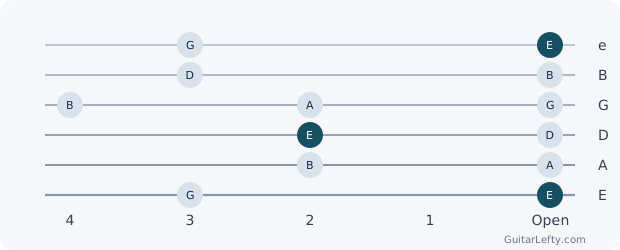
Make a small phrase: E–G–A–G–E using low E open, low E three, A open, low E three and low E open. Play the first four notes as quarter notes, then hold the final E through the next bar. Repeat, then change the length of one note.
Compare the open-position feeling with A minor at fret five. The minor-pentatonic interval structure is the same, but the physical movement differs because open strings replace some fretted notes. A movable shape and an open shape are useful for different reasons. You do not have to choose only one.
Hear G major pentatonic
G major pentatonic is G, A, B, D and E. Those are the same pitch classes as E minor pentatonic, but G is now the intended home note. The musical centre comes from the harmony and how you phrase, not from the order in which a list happens to be printed.
Try this rising one-octave route: low E three for G, A open for A, A two for B, D open for D, D two for E, and G open for the upper G. Then return through the same locations. Notice the leap from B to D, where C is absent.
Strum a G chord before playing the route. Finish on G and let it ring. Then strum Em and play the E minor route, finishing on E. The shared notes are easier to understand when you hear two different centres rather than only compare two diagrams.
Use G major pentatonic and the comparison tool to see the overlap. Do not assume that changing the first note of a scale run is enough to make an entire piece major or minor. The surrounding chords and repeated points of rest matter too.
Make a G-major phrase using G–B–D–B–G. Use low E three, A two, D open, A two and low E three. Give the final G extra time. This small collection outlines the G major triad, so it is a useful first sound to hear against a G chord.
Use rhythm and silence to shape the idea
Pick three notes from a scale and stay with them for a full minute. For A minor, try A, C and E. Play three steady notes, pause, then repeat them with a different rhythm. A limited note choice makes it easier to hear the effect of timing.
Try a question-and-answer exercise. Play a short idea in one bar, leave a bar of space, then play a related answer. The answer might use the same rhythm but finish on A. It might begin on the same note and move lower. Keep one feature shared so the two parts sound connected.
Count through the empty bar. Silence still has a length. If you stop counting whenever you stop playing, the next phrase may arrive by guesswork. A metronome or simple backing can make this easier to notice, but you can begin by counting aloud.
Change note lengths deliberately. A short note followed by a rest feels different from a note that rings through the same space. Muting ends the sound; doing nothing may let it continue. Practise both so you can choose whether a phrase breathes with silence or with a sustained note.
Record a thirty-second attempt. Listen for a repeated idea, an intentional gap and a clear ending. If you hear only a stream of notes, reduce the choices. Two or three notes with a memorable rhythm can give you a stronger musical starting point than the whole pattern.
Connect locations without memorising everything
A root is a useful bridge between parts of the neck. In A minor pentatonic, find A at low E five and D seven. Play a phrase ending on the first A, then repeat a similar idea near the second. You are moving to another part of the neck while keeping the same tonal centre.
To connect adjacent windows, choose one note shown in both. Play up to that note in the first view, pause, then continue using the second view. Do not try to swallow two complete diagrams at once. The shared location is a landmark that keeps the transition understandable.
You can also connect along one string. On high e, A minor pentatonic appears at frets five, eight, ten, twelve, fifteen and seventeen for A, C, D, E, G and A. Play slowly and say the names. This shows the intervals without changing strings, though the larger movement creates a different physical task.
For a first slide, choose a short, comfortable distance between two scale notes and keep the rhythm simple. Name the destination before moving. A slide is not just travelling somewhere vaguely higher; it is arriving on a specific note at a specific time.
The CAGED guide later connects chord forms and roots around the neck. You can explore those ideas when useful, but you do not need to master five complete shapes before making a good phrase in one small area.
Fit the scale to the chords underneath
For your first A minor pentatonic experiments, use a simple A minor chord or a clearly A-minor-centred backing. Aim for A, C or E as places to rest, because those are the notes of the Am triad. D and G can provide movement between them.
When the chord changes, listen again. Over Dm, D, F and A are chord tones, and F is not in A minor pentatonic. You can still use the pentatonic collection musically, but it does not describe every important note of every chord. That is a reason to learn harmony gradually, rather than a flaw in the scale.
Minor pentatonic is also used over major or dominant blues harmony, where some of its notes create deliberate tension. That is a stylistic choice requiring listening and phrasing. It is different from a general rule that any minor pentatonic scale fits any major progression with the same root name.
Major pentatonic can sound clear over a suitable major tonic, but changing harmony may still ask for care. G major pentatonic contains B, which can rub against the C note of a C chord if you hold it prominently. Try resolving or choosing another note and hear the difference.
Keep early backing simple enough that you can hear these relationships. If a busy track makes every choice feel uncertain, return to one chord. Learning what a settled note sounds like is a useful foundation for choosing tensions on purpose later.
Answer a phrase in another octave
Take the earlier two-bar A-minor phrase and move it one octave higher. Use D seven for A, G five for C, G seven for D and B five for E. The note names and rhythm stay the same, but the phrase occupies a higher register.
Play A–C–D–rest in the first bar and E–D–C–A in the second, with one event per beat. Repeat it first in the lower location, then the higher one. Say the destination string names before moving if that helps you avoid a hurried jump.
Listen to how the register changes the weight of the phrase. The higher answer might sound more open or more insistent, depending on your touch and backing. You have created contrast without adding a new scale or a faster passage.
Now keep the lower phrase as written and change the upper answer’s final bar to E–C–D–A. The answer still shares the rhythm, note collection and final root, while its middle movement differs. That is a manageable way to develop an idea rather than abandon it for a completely unrelated run.
Check unwanted ringing as you cross strings. If the lower phrase remains sounding underneath the upper one, decide whether that overlap is intentional. A clear release can make the question-and-answer effect easier to hear. Practise the move slowly before adding a backing.
Listen, name and remember a small idea
Choose a three-note idea and sing or hum it quietly before playing. You do not need a polished singing voice. The purpose is to imagine the contour and timing instead of letting your fingers choose every note by habit.
For example, imagine A–C–A with the first A short, C short and the final A held. Find it at low E five and eight, then repeat it using D seven and G five. You are connecting an imagined sound with two physical locations.
Next, play A followed by either C or E and listen to the difference. C is the minor third above A; E is the fifth. You can begin recognising those relationships through repeated examples, without expecting yourself to name every interval correctly on the first day.
Write down one phrase you would like to keep. Include the string and fret locations, a count, and any deliberate silence. A title such as “short question, long A” can help you remember its character. A list of fret numbers alone may not preserve the rhythm that made it interesting.
Return to that phrase in your next session before inventing another. See whether you can play it from memory, then check your note. Recalling an idea is a different skill from improvising a new one, and both are useful when you want a solo to contain something recognisable.
If you cannot reproduce it exactly, compare the new version with the written one. You may prefer the change, but notice what changed: rhythm, note order, register or touch. Making that comparison deliberately helps turn an accidental variation into a choice you can use again.
When you keep a phrase, also note the backing chord you used. A note that felt settled against Am may create a different effect against another chord. Remembering that context helps you understand why the idea worked, rather than treating it as a pattern that must fit everywhere.
A practice plan that turns patterns into music
Spend two minutes finding roots in one window. Spend two minutes on a short ascending and descending route. Spend three minutes repeating and varying one phrase. Use another two minutes for question and answer over a quiet backing, and finish by saving one idea you liked.
On the next day, keep the same notes but change the rhythm. On another day, keep the rhythm and move the ending. This gives you a controlled experiment: you can hear what one decision changed. Adding a new scale every session makes that comparison harder.
If the notes are unclear, slow down and mute unwanted strings. If the phrases sound aimless, finish more often on a root or chord tone. If the rhythm wanders, reduce to one repeated note until the pulse settles. Solve the musical problem you hear rather than automatically adding more scale practice.
For your next session, choose one of these three sounds: A minor around fret five, E minor in open position, or G major in open position. Play a short idea, leave space and answer it. That is enough material for useful improvisation practice, and it gives every new note you learn a job.
Prepared for Guitar Lefty with AI assistance. The written exercises are original teaching examples. All fret numbers assume standard tuning unless stated otherwise.