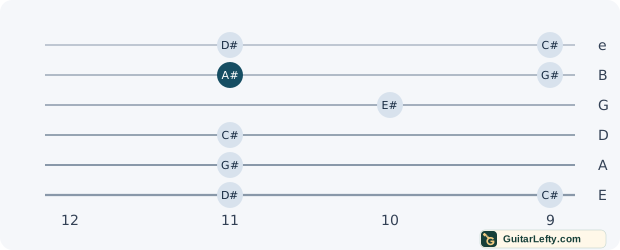
Start over a minor-key backing progression. In blues, its minor third can also create deliberate tension over major or dominant chords.
Make a short phrase, leave a space, and finish on A#. Listen to how the same note changes against a different chord.
Reading the tab below
Tab keeps high e at the top and low E at the bottom for both hands. Numbers are frets; play from left to right. A 0 means an open string. Finger 1 is your index finger and 4 is your little finger.
03 · Connect the shapes
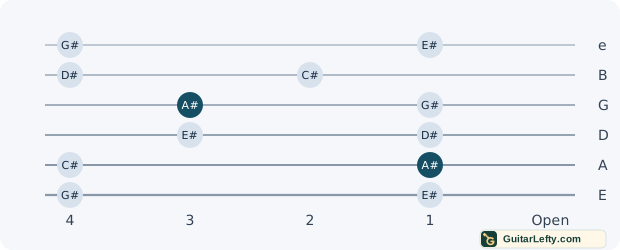
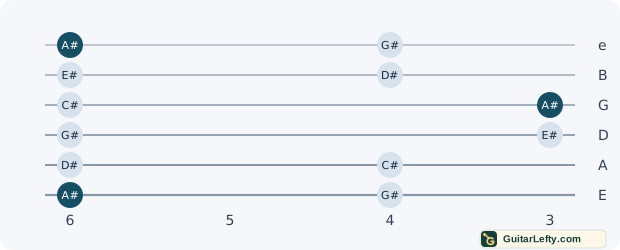
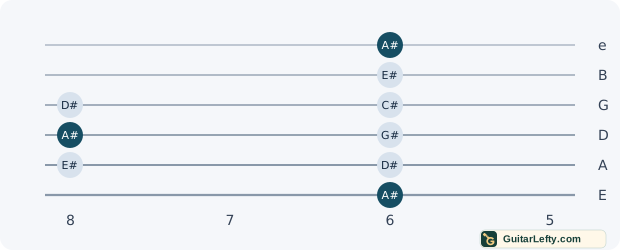
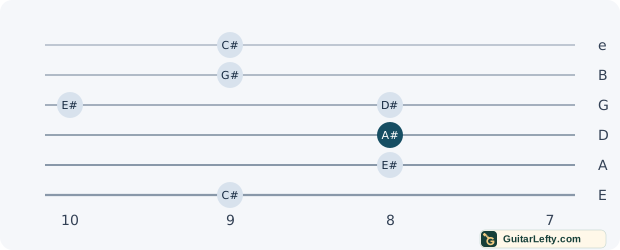
Five connected views of A# Minor Pentatonic
Each picture shows the scale notes in a small area of the neck, called a fret window. Neighbouring pictures share some frets. Find the roots, then use a shared note to move between the views. You can choose your own fingering; these pictures use the same notes as the interactive fretboard and printable sheet.
Window 1 · open positionWindow 2 · from fret 3Window 3 · from fret 5Window 4 · from fret 7Window 5 · from fret 9
04 · Put it to music
Chords and a progression to try
Hear the harmony, then return to your scale. Chord diagrams are mirrored for left-handed guitar; high e is on the left. Movable triad voicings are provided for chords outside the beginner library.
05 · A little guidance
Questions before you play
Do I need to learn all five patterns at once?
No. Learn a short phrase in one comfortable area first. Add a neighbouring pattern when you can find the root and play cleanly.
Are these different notes from a right-handed guitar?
The notes and standard tuning are the same. The diagrams mirror the fretboard so you can read them for a left-handed instrument.
What if a stretch is uncomfortable?
Slow down, release excess pressure and shift position or choose another window. Stop if playing hurts.