
CAGED connects five familiar major chord forms around the guitar neck: C, A, G, E and D. For a left-handed player, the physical picture is mirrored, but the notes, roots and order of the forms stay the same. Start by finding one chord in several places, rather than trying to memorise five large scale boxes.
This guide uses C major as a worked example. You will see full forms as maps, then choose smaller voicings that are more practical to play. You do not have to grip every string in every form for the system to be useful.
Separate the shape name from the sounding chord
An E-shaped chord is not always E major. The name describes a familiar arrangement of notes and fingers based on open E. Move that arrangement to another fret, replacing the open-string positions with fretted notes, and it can produce a different major chord.
For example, 355433 is an E-shape G major chord. Its lowest note is G at low E fret three. The E-shape spacing is still recognisable, but G names the actual harmony. Keeping those two labels separate prevents a great deal of CAGED confusion.
The same is true of an A shape producing C major or a D shape producing C major higher on the neck. CAGED asks you to recognise the form and locate its roots, then connect it with nearby forms of the same chord.
All recipes here run from low E to high e. X means omit a string. When a fret number has two digits, we separate the six string entries with dashes so the written recipe remains clear. Do not mirror this written low-to-high order when playing left-handed.
If full barres are new, read the barre-chord guide alongside this one. That guide focuses on making the grips clear. This one focuses on how the chord locations relate across the neck.
See C major in five connected forms
C major contains C, E and G. Every voicing in this table contains only those notes, with some repeated in different octaves. The forms are listed in their connected order from open position towards higher frets.
| Form | Low E to high e | Useful C root locations |
|---|---|---|
| C form | x–3–2–0–1–0 | A 3, B 1 |
| A form | x–3–5–5–5–3 | A 3, G 5 |
| G form | 8–7–5–5–5–8 | Low E 8, G 5, high e 8 |
| E form | 8–10–10–9–8–8 | Low E 8, D 10, high e 8 |
| D form | x–x–10–12–13–12 | D 10, B 13 |
Do not try to perform the entire table immediately. First locate one C in each area and play it alone. Then add one other chord tone nearby. You are learning addresses and connections, which does not require every full grip to be comfortable today.
Notice how neighbouring forms share roots or nearby chord tones. C and A forms meet around A three. A and G forms connect around the middle strings near fret five. G and E forms meet around the E-string Cs at fret eight. These overlaps are the useful part of the map.
After the D form, a higher C form continues the cycle: x–15–14–12–13–12. The pattern of relationships repeats an octave above the original open C. The neck does not suddenly end at the fifth form; CAGED is a repeating view.
The C form: begin with something familiar
Play open C, x32010. Ring frets A three, middle frets D two and index frets B one. G and high e remain open. Pick the five intended strings and say the notes: C, E, G, C and E.
Find the roots on A three and B one. Those two Cs are important landmarks. Try playing just C on A, E on D and G open. You have outlined the triad without sounding the whole voicing.
To understand the movable C form, imagine every open-string location becoming a fretted location by the same amount. Moving the whole form up two frets gives x54232, D major. A five is D, D four is F sharp, G two is A, B three is D and high e two is F sharp.
The moved form can be awkward as a full grip. Use it as a note map before treating it as a performance requirement. A small group such as G two, B three and high e two already makes a D major triad. You can hear the relationship without forcing the entire shape.
Return to open C and notice which notes would need the index when the form moves. The open strings are not magical exceptions; they are positions supplied by the nut. A movable form has to account for them too.
The A form: share the A-string root
Keep C as the sounding chord and move to x35553. This is an A-shaped C major. A three is still the bass C, but the upper notes now sit mostly at fret five. The notes from A to high e are C, G, C, E and G.
Play the bass root alone, then the middle three notes at D five, G five and B five. Those middle notes are G, C and E. You can omit the high e deliberately and use x3555x if that is clearer or suits the sound.
For the full form, index can cover fret three while other fingers fret D, G and B at five. Some players use separate fingertips and others a ring-finger partial barre. Choose a comfortable, clear version. CAGED does not demand one particular joint position.
Compare open C with this C. The chord identity stays the same, but the register and note arrangement change. Strum each gently and listen. A different voicing can change the texture of an accompaniment without changing its chord progression.
Practise alternating one bar of open C and one bar of A-form C. Keep the rhythm very simple. Then pick just one root and one other note from each location. This makes the connection manageable before you add larger movements.
The G form: use the map without forcing the grip
The full G-shaped C major is 875558. From low E to high e, the notes are C, E, G, C, E and C. The shape comes from moving a G-major form so its low root reaches C at fret eight.
This full voicing asks for a broad reach, and you do not need it as a beginner grip. Find the low E C at eight, the G-string C at five and the high e C at eight. Those roots make the outline visible even if you never strum all six notes together.
Now play only D five, G five and B five: G, C and E. That small voicing overlaps the A-form area you just used. The overlap is not a problem or a naming contradiction. CAGED forms describe connected regions, and useful small note groups can belong to more than one view.
Try G five, B five and high e eight for C, E and C. This omits the fifth, G, so it is a partial C-major sound built from root and third rather than the complete triad. Use it to hear the major third clearly, then return to a three-note C–E–G group.
Think of the G form as a way to organise roots and nearby tones. If the full stretch creates strain, choose smaller groups and move the hand. Learning the map should make musical choices easier, not persuade you that an uncomfortable six-string grip is mandatory.
The E form: connect the E-string roots
For E-shaped C major, use 8–10–10–9–8–8. Index covers fret eight, middle frets G nine, ring frets A ten and little finger frets D ten. The sounding notes are C, G, C, E, G and C.
Find C on low E eight, D ten and high e eight. Compare those locations with the G-form roots. The E-string Cs at eight are shared landmarks, helping you understand how the two forms meet.
Try the upper four strings only: D ten, G nine, B eight and high e eight. They sound C, E, G and C. That compact voicing is useful for hearing a root-position major triad with a repeated root on top.
Now compare the A-form C near fret three with this E-form C near fret eight. The lowest root moves from the A string to the low E string. The shape changes, but the note names remain within C, E and G. Say the root location before making the move.
When a progression needs a major chord elsewhere, the E form gives you a familiar movable choice. Learn the low-E root names so you can choose G at three, A at five or C at eight deliberately, rather than counting a shape up from open E every time.
The D form: find a useful upper-neck voicing
D-shaped C major is x–x–10–12–13–12. D ten is C, G twelve is G, B thirteen is C and high e twelve is E. The bass root has moved to the D string.
The full four-string form may require a stretch or a carefully chosen fingering. Start with the three thin strings at twelve, thirteen and twelve. Those notes are G, C and E, a complete C major triad with G as its lowest sounding note.
Add the D-string C at ten when comfortable, or leave it out deliberately if another instrument supplies the bass. The smaller voicing is not incomplete as harmony; it contains all three chord tones. Adding the bass C changes its register and bass arrangement.
Find B thirteen as a root landmark. It connects with the next higher C form, whose B-string root is also thirteen. Play that C alone, then a nearby E and G. You have crossed into another region without needing to jump between two entire memorised boxes.
Upper-neck access depends on the instrument and your position. Move the body or neck angle gently if needed, and do not force a wrist bend to reach a diagram. You can learn the relationship on a fretboard map even when a particular guitar makes the highest grip less convenient.
Practise the root route before larger patterns
For C, follow this small route: B one, A three, G five, low E eight, D ten and B thirteen. These are all Cs in different octaves or locations. Play them slowly and say the string and fret. The route is a set of landmarks, not an ascending melody in every step.
That final point matters. Moving to a higher fret number does not always mean the pitch rises when you also change strings. If your exercise is meant to ascend, check the actual pitches. A root-finding exercise can jump between registers as long as you understand what you are doing.
Choose two neighbouring roots and find a third and fifth nearby. For example, around A three, use D two for E and G open for G. Around G five, use B five for E and D five for G. These small triads give the root locations a sound.
Repeat the process with another major chord when C is clear. Do not begin by memorising a second full table blindly. Find the new roots, move one known form, check its notes and build the neighbouring connection from there.
The interactive fretboard can confirm note locations. Use it to answer a question, then try the answer on the instrument. The practical skill is finding the note again when the screen is not making the choice for you.
Connect the chord forms with a scale
C major scale contains C, D, E, F, G, A and B. Its C-major chord tones are C, E and G. In any CAGED region, those three chord tones sit within the larger scale collection. Finding them helps you hear which notes outline the harmony.
Start with a small C-major voicing, then play a nearby D or F as a passing note before returning to a chord tone. Listen against a C chord or a simple C-centred backing. You are using the scale to travel between stable landmarks rather than running an entire pattern by default.
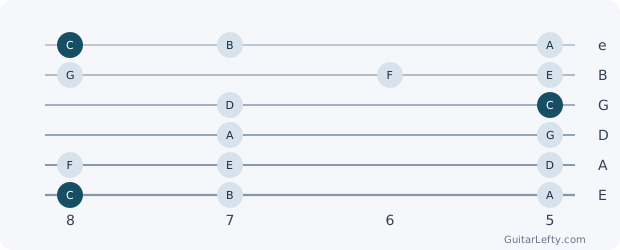
Our scale windows are not labelled as the five CAGED forms. They overlap portions of the neck for display. You can use them to locate chord tones, but do not assume that window one must equal C form, window two A form, and so on.
Pentatonic patterns can also connect with chord forms. C major pentatonic contains C, D, E, G and A, including all three C-major triad tones. Begin with one region and hear the relationship. Learning five large patterns simultaneously can hide the simple connection you are trying to understand.
For minor harmony, the major-form map is not a direct instruction to play unchanged major chords. You need the appropriate minor third and suitable forms. Learn the major connections clearly, then explore how minor voicings and scales alter them.
Use CAGED in short musical exercises
One chord, two textures: play open C for one bar and A-form C for one bar. Keep the same gentle rhythm. Notice how the upper notes and bass arrangement change the colour while the harmony remains C major.
A root and an answer: play C on A three, then answer with a short C–E–G phrase nearby. Move to the C at G five and make another small answer using chord tones in that region. Leave a bar of space between ideas.
Small voicing, clear pulse: alternate a C triad with a G triad that you can reach comfortably. Begin with open or familiar forms rather than demanding the closest theoretical fingering. The CAGED map should support your choice, not override your ability to play in time.
Follow one chord tone: find E within two C-major forms and let that note connect the change. Hearing a shared tone can make the transition sound smoother. You are beginning to think about how individual voices move, rather than only where a whole grip sits.
For every exercise, keep one variable simple. If the location is new, use a plain rhythm. If the rhythm is new, choose a familiar voicing. Small controlled experiments make the system useful more quickly than a large diagram-learning challenge.
Clear up the common confusions
Is CAGED five different chords? The letters name five forms. In our worked example, all five produce C major. You can also use the forms for different sounding chords by moving them to suitable roots.
Must I play the full G form? No. Its note map and root locations can be useful even if you choose only small voicings. Do not force an uncomfortable stretch as proof that you understand the system.
Are five fret windows the same as CAGED? No. A display window is a portion of the neck. A CAGED form is based on a chord structure and its roots. Their boundaries can overlap without being identical.
Does every solo need to follow CAGED? No single navigation system is compulsory. This is one useful way to connect familiar shapes, chord tones and scale notes. Keep what helps you hear and find music, and avoid treating the map as a set of rules about what you are allowed to play.
For another teacher’s explanation of the five movable forms, see GuitarLessons’ CAGED lesson. Compare the root relationships and translate the physical view carefully for left-handed playing.
Check the map without looking at a full chart
Cover the large table and ask yourself for one C root on each of three strings. You might choose A three, G five and D ten. Find each note, then name a nearby E or G. If you need the chart, check it and repeat just that small connection.
Next ask for two C-major voicings with different lowest notes. Open C begins with C on A three. The three-note group D five, G five and B five begins with G. Both contain C, E and G, but their bass arrangement differs. Hear that difference before trying to label every possible inversion.
Now explain one form aloud as though helping another beginner: “This is an A shape, but it sounds C major because its root is C at A three.” If you can say what names the shape and what names the chord, you have understood a central distinction.
Finally, choose a simple two-chord progression and find an alternative location for one chord. Play the original version first, then the alternative, using the same rhythm. Decide which texture you prefer for that small arrangement. CAGED becomes useful when the extra location offers a choice you can hear, rather than merely another diagram to recall.
Save one connection in your practice notes, including string names and frets. Revisit it tomorrow before adding another form. A small map you can use from memory is a good result, and it leaves a clear place for the next connection to attach.
When naming a voicing, check its lowest sounding note as well as its chord tones. That bass choice can explain why two correct C-major versions sound different, even when you play them with the same rhythm.
A useful next session
Choose just C form and A form for C major. Find their roots, play a small voicing from each, and alternate them with one strum per bar. Then choose three scale notes nearby and make a short phrase ending on C.
In the next session, add the G-form root map without demanding its full grip. Later connect E and D forms. You can spend several sessions on each connection. The sequence is there to organise the neck, not to set a deadline for your hand.
Keep returning to sound: name the chord, hear its third, find its root and use a voicing in time. When those jobs become clearer, CAGED is doing something useful. You are turning a long fretboard into a few connected places where you know how to make music.
Prepared for Guitar Lefty with AI assistance. The written exercises are original teaching examples. All fret numbers assume standard tuning unless stated otherwise.